Best overall: a documented 1996–1997 F355 Berlinetta manual; best for early specification: a 1995 Berlinetta; best for transmission history: a 1998–1999 F355 F1. If you are comparing a Ferrari F355 for sale in 2026, use those years to build your shortlist, then let service documentation, originality, and inspection findings decide the purchase.
- For a Ferrari F355 for sale, prioritize documented condition over model year or advertised mileage.
- The 1996–1997 F355 Berlinetta manual is the default shortlist for buyers wanting a fixed roof and gated gearbox.
- Choose a 1995 F355 for early specification, not an assumed mechanical advantage.
- Mission Motorsports serves exotic and collector car buyers; ask directly about a specific vehicle and its documentation.
Why this matters
An F355 model year tells you less than a detailed service file. A later car with undocumented maintenance is not a better purchase than an earlier example supported by invoices and a specialist inspection.
Mission Motorsports is a Franklin-based exotic and collector car dealership serving Nashville, Middle Tennessee, and buyers across the United States. For a particular F355, contact Mission Motorsports to confirm whether a suitable vehicle is listed or discuss sourcing; establish its exact specification before arranging an inspection.
Mission Motorsports is best suited to Ferrari F355 buyers seeking a specialty exotic and collector car dealership rather than a general used-car outlet.
What makes the best used Ferrari F355?
Use these criteria to compare cars in 2026:
- Service documentation: Request itemized invoices identifying the vehicle, dates, mileage, work performed, and workshop.
- Mechanical evidence: Commission an F355-experienced specialist to evaluate engine health, exhaust components, cooling, and transmission operation.
- Factory specification: Verify body style, original transmission, market specification, colors, and documented modifications.
- Structural and cosmetic condition: Compare paint readings, panel fit, underbody condition, and repair records rather than relying on photographs.
- Ownership and title history: Reconcile the seller’s identity, title, chassis number, mileage entries, and any lien before payment.
No year wins every category. A gated manual answers a different brief from an F1 car, while a removable roof introduces checks that a Berlinetta does not need.
Best F355 years at a glance
These are buying priorities, not claims that every example from a particular year has the same condition or equipment. Confirm build information and market specification on the individual car.
| Years and configuration | Best for | Standout characteristic | Key limitation |
|---|---|---|---|
| 1996–1997 F355 Berlinetta manual | Default fixed-roof shortlist | Gated manual without a removable or folding roof | Year alone establishes neither engine health nor maintenance quality |
| 1995 F355 Berlinetta manual | Early-specification interest | Early cars use Bosch Motronic 2.7 engine management | Originality and market specification require careful verification |
| 1998–1999 F355 F1 Berlinetta | Transmission-history collectors | Ferrari’s first road-car application of its F1 electrohydraulic shift system | Adds hydraulic actuation and control-system inspection requirements |
| 1996–1999 F355 GTS manual | Removable-roof driving | Targa-style removable roof panel | Panel fit, seals, and storage condition need inspection |
| 1996–1999 F355 Spider manual | Fully open driving | Folding fabric roof | Roof mechanism and fabric condition add inspection work |
1. 1996–1997 F355 Berlinetta: best for a default shortlist
The 1996–1997 F355 Berlinetta manual is a sensible starting point because it combines a fixed roof with the gated manual transmission. This recommendation is about configuration, not a claim that these years eliminate the F355’s known inspection concerns.
Ferrari’s F355 Berlinetta technical archive identifies the model’s 3.5-liter V8, five valves per cylinder, and six-speed manual transmission. Those fundamentals explain the appeal; they do not substitute for evidence about the engine installed in the car you are buying.
1996–1997 Berlinetta pros:
- Fixed roof removes convertible-top inspection from the purchase.
- Gated manual provides the traditional F355 driving configuration.
- Clear specification brief makes competing listings easier to compare.
1996–1997 Berlinetta cons:
- These years do not guarantee documented valve-guide work or healthy exhaust manifolds.
- A recent maintenance invoice still needs scrutiny for scope and exclusions.
Best for: Buyers who want a fixed-roof manual without making early specification or F1 technology the central objective.
Verdict: Buy when specialist inspection and documentation support the specific car.
2. 1995 F355 Berlinetta: best for early-specification interest
A 1995 F355 Berlinetta belongs on your list when early configuration matters to you. Early F355s use Bosch Motronic 2.7 engine management, while later production adopted Motronic 5.2; confirm the actual installation and market specification rather than relying solely on registration year.
Do not turn that distinction into a blanket reliability ranking. An early car’s appeal depends on what remains original, what has changed, and whether the changes have supporting documentation.
1995 Berlinetta pros:
- Distinct early engine-management configuration gives the purchase a specific collecting rationale.
- Fixed-roof body suits buyers who do not need open-air use.
- Manual transmission fits an early-specification buying brief.
1995 Berlinetta cons:
- Model year is not evidence that valve guides, manifolds, or other components have been addressed.
- Undocumented replacement parts complicate an originality assessment.
Ask for photographs and invoices covering engine-management changes, exhaust alterations, and engine repairs. Have the inspecting specialist reconcile the records with the installed components.
Best for: Collectors who specifically want early F355 specification and will investigate its authenticity.
Verdict: Buy for a verified early configuration; skip any example sold on early-year reputation alone.
3. 1998–1999 F355 F1: best for transmission-history collectors
The F355 F1 introduced Ferrari’s electrohydraulically operated F1 transmission to its road-car range. It uses paddle-controlled actuation of a manual gearbox, not a modern dual-clutch transmission.
Choose this configuration because you want that technology, not because you expect contemporary automatic-transmission behavior. A specialist should assess engagement, shifting, hydraulic operation, clutch condition, and faults using equipment appropriate to the car.
1998–1999 F355 F1 pros:
- Holds a defined place in Ferrari road-car transmission history.
- Provides paddle-operated shifting for buyers who prefer that interface.
- Berlinetta body keeps roof complexity out of this particular shortlist.
1998–1999 F355 F1 cons:
- Hydraulic actuation adds components beyond the conventional manual arrangement.
- Smooth operation during a brief demonstration does not replace diagnosis.
For a 2026 purchase, request invoices for clutch and actuator-related work, including the underlying diagnosis. Confirm whether the car retains its factory transmission configuration; a conversion needs its own documentation review.
Best for: Buyers collecting Ferrari transmission development rather than seeking a substitute for a current automatic.
Verdict: Buy for its specific historical role; skip if modern automatic behavior is essential.
4. 1996–1999 F355 GTS: best for removable-roof driving
The F355 GTS gives you a removable roof panel rather than a folding fabric top. Choose the body style first, then compare documented examples across these years instead of assuming the final year is automatically preferable.
Inspect the panel installed and removed. Check its fit, latches, seals, finish, and designated storage arrangement, and look for evidence of water entering the cabin.
1996–1999 GTS pros:
- Removable panel provides an open-roof experience without a fabric convertible top.
- Manual configuration preserves the gated-shifter brief.
- Roof condition can be evaluated directly during a physical inspection.
1996–1999 GTS cons:
- Panel and seal condition add checks beyond the Berlinetta.
- Missing or incorrect roof-related components complicate a completeness assessment.
Ask the seller to demonstrate removal, storage, and refitting rather than supplying only roof-off photographs. Have a specialist distinguish cosmetic wear from fit or water-ingress problems.
Best for: Buyers who want open-roof driving but do not want a full convertible.
Verdict: Buy when the roof assembly is complete, fits correctly, and accompanies a sound mechanical inspection.
5. 1996–1999 F355 Spider: best for fully open driving
The F355 Spider is the choice when the convertible experience is your priority. The folding fabric roof changes the inspection brief; it does not justify accepting weaker engine documentation or unresolved structural concerns.
Have the seller operate the roof through its complete cycle. Inspect fabric, stitching, seals, alignment, hydraulic components, and evidence of moisture in the cabin.
1996–1999 Spider pros:
- Provides the fully open configuration within this shortlist.
- Manual examples combine convertible driving with a gated shifter.
- A clear body-style preference helps you reject unsuitable listings early.
1996–1999 Spider cons:
- Roof operation introduces additional mechanical and hydraulic checks.
- Attractive fabric does not establish the condition of concealed components.
Compare roof-related invoices with the present operation. A description such as serviced top is not enough; ask which components were repaired or replaced and why.
Best for: Buyers who will actually use and value the convertible configuration.
Verdict: Buy for open-air use, but wait until any roof fault has a documented diagnosis.
How to evaluate an F355 before committing
Use the same sequence whether you buy near Nashville or arrange a remote purchase elsewhere in the United States.
Records review
Start with the chassis number, title details, service invoices, ownership chronology, and factory-specification evidence. Build a dated mileage sequence and investigate contradictions before discussing payment.
The collector car provenance checklist provides a framework for organizing that evidence. Treat seller descriptions as leads to verify, not as substitutes for records.
Specialist inspection
Ask an F355-experienced specialist to define the inspection scope in writing. Engine assessment, diagnostic checks, exhaust examination, cooling-system evaluation, paintwork detection, and underbody inspection should answer separate questions.
Ask whether compression and leak-down testing are appropriate, and request interpretation of the results. A clean vehicle-history report does not establish original paint or eliminate the need to examine previous repairs.
Findings review
Separate routine maintenance from unresolved faults and undocumented claims. For timing-belt service, confirm the work date, mileage, included components, and supporting invoice; do not impose a universal interval without consulting the applicable maintenance guidance and specialist.
A major-service description does not prove that valve guides, exhaust manifolds, or every aging component were addressed. Read the actual work order.
Transfer planning
Before funds move, confirm the titled owner, lien status, payment instructions, purchase agreement, and required transfer documents. Independently verify any changed payment instructions through an established contact method.
For transport, confirm the carrier, insurance documentation, collection arrangements, and condition-report process. Photograph the vehicle at collection and delivery, and clarify registration and tax requirements with the relevant authorities.
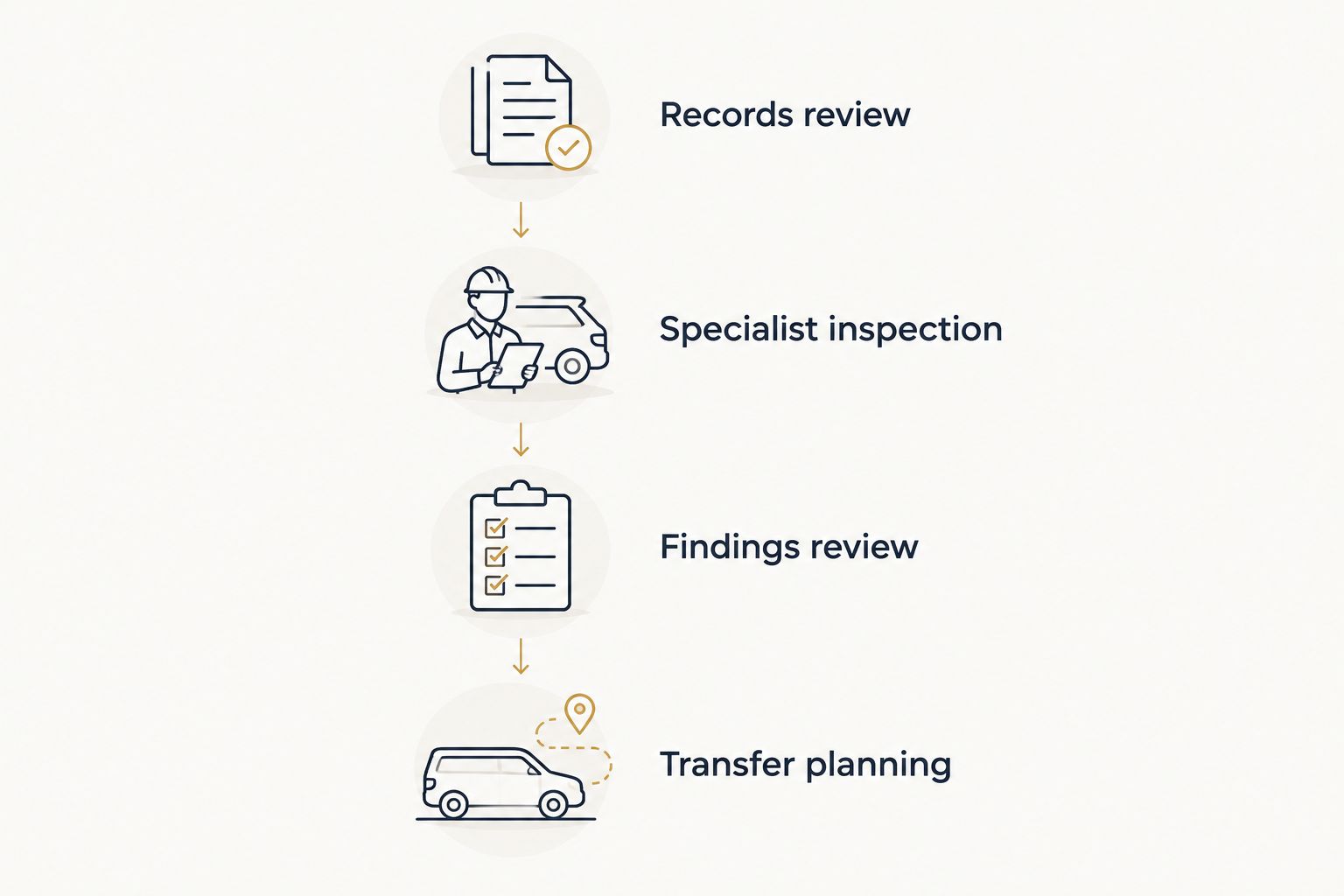
How these F355 choices are ranked
The ranking prioritizes a clear use case, verifiable specification, and a manageable inspection brief. The fixed-roof manual is the default; early specification, F1 technology, removable-roof driving, and full convertible use each earn a separate recommendation.
This is a configuration guide for 2026, not a ranking of individual cars or a forecast of appreciation. No F355 year guarantees investment performance.
Which Ferrari F355 should you choose?
Start with a documented 1996–1997 Berlinetta manual if you are undecided. Expand the search when another example offers stronger records and inspection findings; do not reject a sound car solely because it falls outside that starting range.
When discussing a Ferrari F355 with Mission Motorsports, identify the listing and ask for the chassis number, service documentation, transmission specification, and known paintwork. Confirm current vehicle details directly before booking travel or inspection.
Discuss your F355 search
Ask about a listed vehicle or discuss your preferred body style, transmission, and documentation requirements.
FAQ
What is the best Ferrari F355 year to buy in 2026?
A documented 1996–1997 F355 Berlinetta manual is the default shortlist in this guide. A better-documented example from another year deserves priority over an unresolved car in that range.
Is a later Ferrari F355 always more reliable?
No model year guarantees the condition of an individual F355. Evaluate service invoices, installed components, specialist findings, and evidence supporting claimed repairs.
Should I buy an F355 manual or F1?
Choose the manual for a conventional gated-shifter experience and the F1 for Ferrari's early paddle-shift road-car technology. The F1 system requires additional attention to hydraulic actuation, clutch operation, and diagnosis.
Does an F355 major service mean everything has been fixed?
No, a major service only establishes the work documented on its invoice. Review the included parts and labor separately from valve-guide, exhaust-manifold, roof, or transmission repairs.
Is low mileage enough to justify buying an F355?
No, low mileage does not establish mechanical health or complete maintenance. Reconcile mileage entries with invoices, ownership records, physical condition, and the specialist inspection.
Can I buy a Ferrari F355 from another state?
Yes, but arrange document verification, an independent inspection, payment safeguards, and transport planning before completing the purchase. Confirm tax, title, and registration requirements for the relevant jurisdictions.
One last thing
The most useful question is not whether an F355 has had its major service. Ask: Which work does the invoice actually prove, and which inspection findings remain unresolved? That question separates an appealing listing from a defensible purchase.